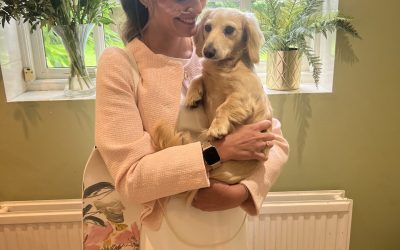
Alice Smail volunteered with Beacon in Summer 2023 while getting her Master’s degree in genomics at the University of Cambridge.
Our communications volunteer, Madison James caught up with her about some of the fascinating rare disease research projects she has been involved in since then.
Alice also produced two courses during her time with us: Introduction to genetics and Introduction to advanced therapies. These free courses are ideal for anyone who wishes to gain a basic understanding of these areas, and are available to enrol in on our Resources Hub now!

I had a great time volunteering at Beacon for Rare Diseases, where I really enjoyed writing about genetics! I have spent the last two years researching two different rare diseases.
Palmoplantar pustulosis (PPP)
Shortly after volunteering, I worked as a research assistant, where I used some cool methods enabled by genetic sequencing to try and better understand a rare skin condition called palmoplantar pustulosis (PPP).
This included analysing RNA-sequencing data from skin samples collected from people with PPP. RNA-sequencing looks at how different genes function, meaning it can be used to try and identify which genes or cellular mechanisms are faulty in a particular condition.
I am still involved in this project, and I hope it can result in effective targeted treatments for PPP in the future!

m.3243A>G disease
At the end of last year I started a PhD project that uses similar genetics methods to investigate the variability of different mitochondrial conditions, such as m.3243A>G disease.
I wanted to do this project because something that I think is really interesting is why people with the same genetic condition can develop different symptoms or experience different levels of severity – for example, some people who carry the m.3243A>G variant can be completely asymptomatic (they have the disease or infection but don’t feel sick or show any signs of it).
My brother’s diagnosis with HIST1H1E syndrome
I am privileged to have a very unique brother called Sam, who has a rare genetic condition called HIST1H1E syndrome. He received this diagnosis about five years ago, and it really made me interested in how tiny genetic changes can influence a person’s life.
Sam is my favourite person in the world and he has made my family’s life much more interesting – we have been lucky to find an excellent HIST1H1E Facebook group, and it is really great to learn about other children and adults with the same condition. It was particularly reassuring to learn that there were affected adults who are much older than him.
In the future, something that I think would be cool for scientists to research is how the HIST1H1E gene influences different behaviours: for example, Sam struggles with sleep and has some unpredictable outbursts, but he is also extremely friendly and says hello to everyone we pass by.
Because of my experiences I can definitely appreciate how important Beacon for Rare Diseases is, and it was great to meet the Beacon team!