
How you can have your say on rare disease care and research: Learning about Patient and Public Involvement and Engagement (PPIE)

Mar 19, 2026

This week’s blog is written by our Senior Patient and Scientific Engagement Officer, Maddie!

Maddie supports two key projects at Beacon:

Maddie explains how you can have your say on rare disease research and care below.

You can find out more about Maddie in her welcome blog here.
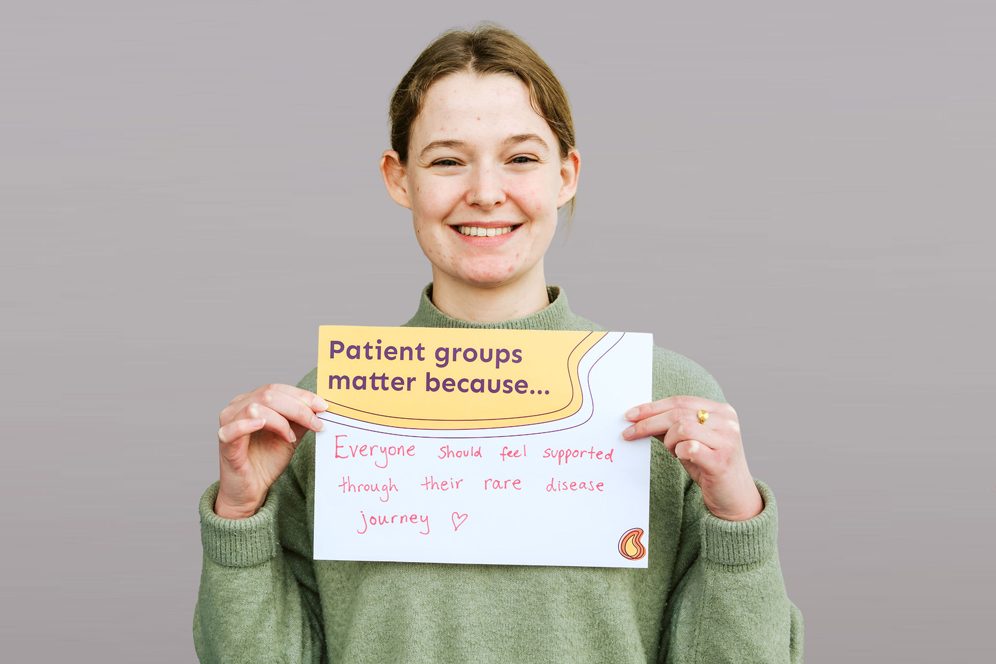
Photo of Maddie holding up a sign that reads "Patient groups matter because everyone should feel supported through their rare disease journey".

Firstly, what is Patient and Public Involvement and Engagement (PPIE)?

Patient and Public Involvement and Engagement (PPIE) means involving and engaging people with research, for example, people from the patient community, family members or carers.

This means that people with lived experience of a condition can help shape research that matters to them.

You may sometimes see it written as ‘PPIE’ for short.

So how does PPIE actually happen practically?

Engagement with research happens through events, such as webinars or in-person information days, where you can learn more about research projects.
Involvement with research can happen in a variety of ways.
For example, researchers might hold online meetings or focus groups to gather input from the community about their projects.
For longer term involvement in a project, you may be able to join a group that meets regularly to provide ongoing input to a project.
These groups are often called:

  • Patient Advisory Groups (PAGS)
  • Lived Experience Advisory Panels (LEAPs)
  • Involvement Groups

These groups can also have different names depending on the condition or organisation.

For example, IMPACT is the name of Mitochondrial Patient Advisory Committee run by the Lily Foundation.

This group is designed to involve people with lived experience of mitochondrial disease, providing opportunities for patients and families to help shape mitochondrial care and research.
Why get involved in PPIE?

Getting involved with PPIE can be a really positive experience for many reasons.
Firstly, you will be taking a proactive step in helping to shape research that matters to you.

By taking part in focus groups or joining an involvement group, you are able to connect with others facing similar challenges, which can build a real sense of community

You will also correspond with researchers and healthcare professionals through involvement work which will give you the opportunity to learn about new research and to ask questions that may not be possible in a more traditional healthcare setting such as at appointments.
Being someone with a rare disease, I wanted to get involved in research to help those in the future avoid the same delay in diagnosis that I experienced.

I hope that working with researchers can help to make their work relevant and impactful to those in the rare disease community.

Clare

Member of the LifeArc TrC4RD PEG

How can I get involved?

If a charity exists for your condition, they will often have an involvement group.

Information about how to join should be accessible on their website.

If you can’t find anything, it may be worth contacting them to ask if they have any ongoing PPIE work to get involved with.

If you run your own charity or patient organisation, you could set up your own involvement group for others in your community to join.

If you don’t quite have capacity for this, other more general PPIE networks exist, such as for local hospitals.

Here at Beacon, we have a Patient Engagement group (PEG) to help us steer work we are doing with the LifeArc Translational Centres for Rare Diseases, as well as a Patient Group Engagement Committee (PGEC), to shape other projects within Beacon.

Unfortunately, all the spaces on these groups are currently filled, but please do keep an eye out as we have many engagement activities, such as webinars and trainings coming up!
Want to learn more about PPIE in rare disease research?

As part of our role in the LifeArc Translational Centres for Rare Disease Hub, we hosted a webinar on the critical role of patient involvement in driving meaningful impact in the rare disease healthcare space.

PPIE is a vital part of rare disease research, helping to improve research quality, relevance and patient impact. Yet despite its importance, it can sometimes be difficult to know where to begin.

Watch our webinar now to:

  • Explore what PPIE is, why it matters, and how to incorporate it into your research projects
  • Discuss the importance of involving patients and the public in your research, and the difference this can make to research outcomes

We will provide practical tips and guidance on embedding PPIE in your projects and more!

Read more blogs