This news post was written by:

Lindsay Birrell, Co CEO of Realise Advocacy and PPIE Lead for RareCare
Josie Godfrey, Co CEO of Realise Advocacy and co-lead investigator for RareCare


How do we know whether rare disease policy is making a difference?
Counting actions and commitments is useful, but it does not tell us whether change is reaching services or improving people’s experience of diagnosis, care and support.
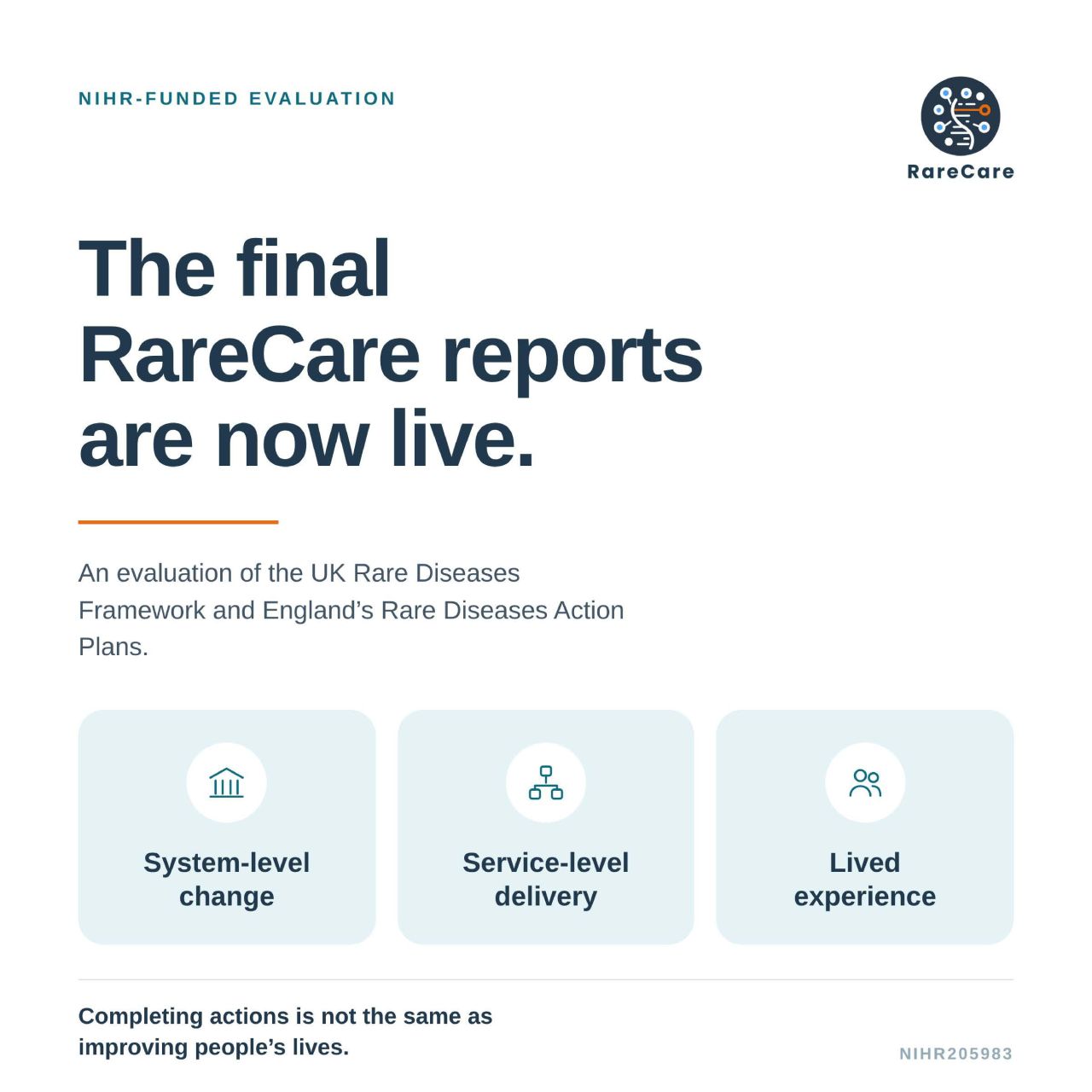
That question was at the heart of RareCare, an evaluation funded by the National Institute for Health and Care Research (NIHR) of the UK Rare Diseases Framework and England’s Rare Diseases Action Plans.
The project brought together evidence from people affected by rare diseases, healthcare professionals and routine NHS data.
Its four reports are now available to read here.
The findings show why it matters to look beyond headline activity
In the RareCare survey,

66% of respondents said they had waited more than a year for a diagnosis

59% said they had no designated person responsible for managing their care
These experiences help show what progress needs to mean in practice:
Better diagnosis, communication, coordination and support
RareCare also explored what the available data can tell us.

Of the 40 indicator conditions examined, only 15 could be identified using hospital codes for individual conditions.
That makes it difficult to measure time to diagnosis consistently across conditions and underlines the need to be clear about what the evidence can show, and where its limits are.
For patient organisations, the reports offer useful questions to bring into conversations with researchers, policymakers and health services:

What changes should people notice?
Are we measuring activity or whether it has improved care?
Whose experiences might be missing?
Want to learn more about RareCare, the reports or how the rare disease community was involved in the project?
Head over to RareCare’s website now!